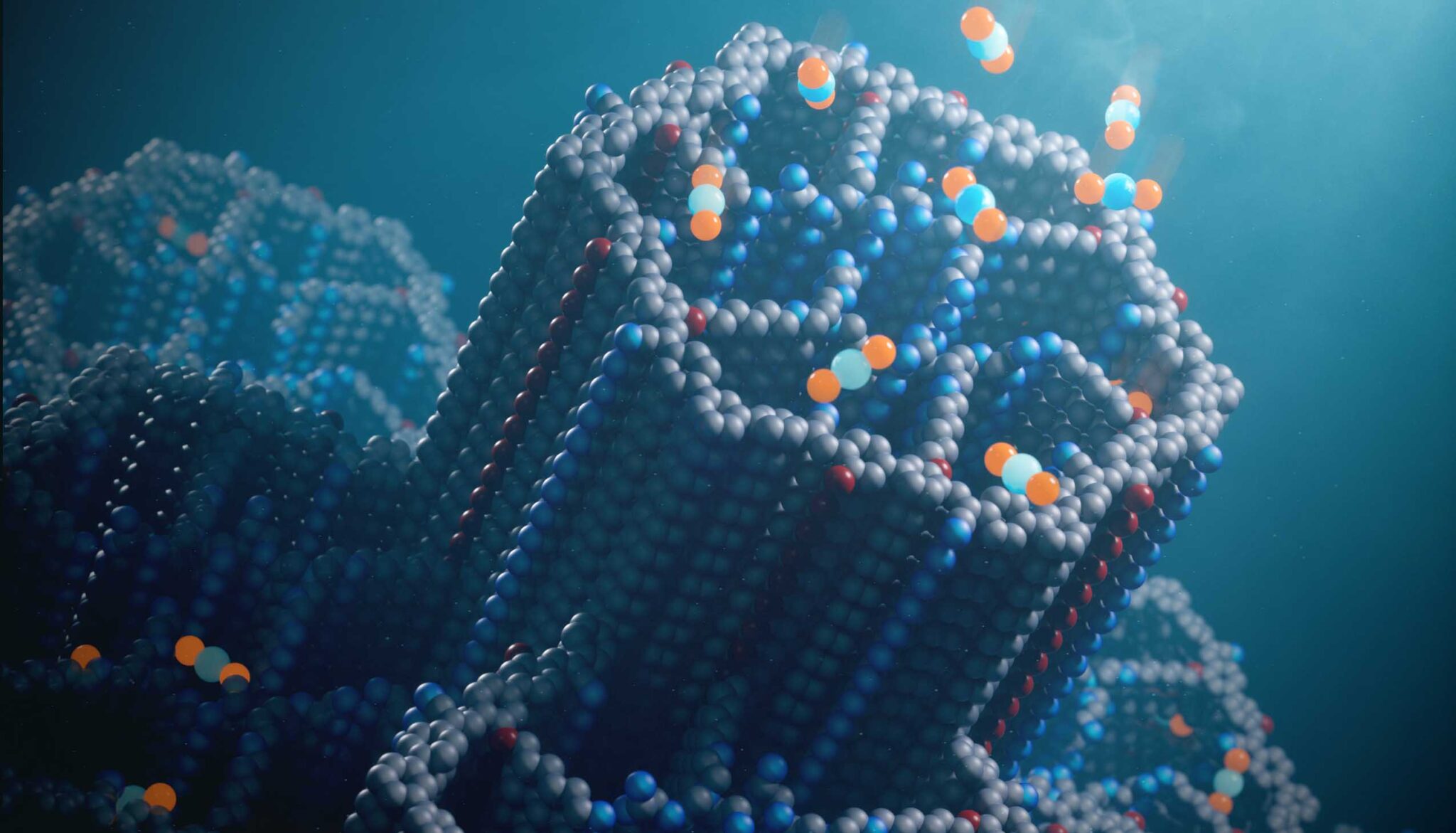
Internal structure of a new material for capturing carbon dioxide. Art by UC Bekeley For decades, the fight against climate change has foc...
For decades, the fight against climate change has focused on two fronts: reducing new emissions and trying to clean up what is already in our atmosphere. While the latter—Direct Air Capture (DAC)—has always been the "holy grail," it has historically been too expensive, too energy-intensive, or too fragile for real-world use.
That narrative changed in late 2024. Scientists at UC Berkeley, led by chemistry pioneer Omar Yaghi, unveiled a new material that acts like a high-tech "molecular sponge." This bright yellow powder, known as COF-999, can pull CO2 out of the ambient air with staggering efficiency.
What Makes COF-999 Different?
Most existing carbon capture technologies use liquid amines to bind with CO2. This process requires massive amounts of energy to heat the liquid and release the trapped gas. Other solid materials often break down when exposed to humidity or other contaminants in the air.
COF-999 (Covalent Organic Framework-999) solves these problems through its unique architecture:
- Atomic "Sticky Fingers": The material is a porous, crystalline structure lined with polyamines. These act like tiny chemical magnets that specifically target and grab CO2 molecules while ignoring oxygen and nitrogen.- The Power of One Tree: Remarkably, just half a pound (200 grams) of this powder can remove as much CO2 from the air in a year as a single mature tree (roughly 20 kg or 44 lbs).
- Extreme Durability: Unlike previous materials that degrade after a few uses, COF-999 has been tested through over 100 "catch-and-release" cycles in actual outdoor Berkeley air with zero loss in performance.
Efficiency and Energy: A New Standard
The true brilliance of this compound lies in its "regeneration" process. To be useful, a carbon-capture material must release the CO2 it has collected so it can be stored or used elsewhere, and the material itself can be reused.
| Feature | Traditional Methods | COF-999 |
| Regeneration Temp | Often >100°C | 60°C (140°F) |
| Energy Source | High-grade industrial heat | Waste heat or solar |
| Saturation Time | Can take many hours | ~2 hours (half-capacity in 18 min) |
| Moisture Impact | Usually degrades performance | Works better in humidity |
Moving to the Next Level: COF-1000
In February 2026, the team took another leap forward by introducing COF-1000. Building on the foundation of its predecessor, COF-1000 features larger internal "highways" for gas transport. This structural redesign allows it to capture carbon dioxide three times faster than COF-999, making it one of the fastest direct air capture materials ever reported.
The Road Ahead: Scaling Up
While a jar of yellow powder won't save the planet on its own, the scalability of this technology is promising. Professor Yaghi envisions massive "cleansing plants" equipped with these frameworks. If deployed in every major city, these systems could theoretically scrub decades of excess carbon from our atmosphere in just a few years.
The researchers are now focused on fine-tuning the manufacturing process to produce the powder in multi-ton quantities. If they succeed, we may soon see "artificial forests" of carbon-scrubbing units doing the heavy lifting in our global race toward net-zero.


